How to Start with Elixir? Introduction, Installation, and Practice

9 March 2021

How to Start with Elixir? Introduction, Installation, and Practice

Codescrum has been using this programming language on a couple of projects, but it is still a strange language in the market and still a little unknown, so in this post, we are going to explore Elixir from the beginning and tell you how we work with it.


What is Elixir?


We cannot talk about Elixir without mentioning Erlang, so we will start this post in the eighties when the development of telecommunication services grew, and the companies needed to offer communication services without any interruption, concurrency, or fault tolerance. Ericsson created an Open Telecom Platform (OTP) called Erlang, and then made it Open Source in the nineties, and we used its advantages to develop other languages and tools.


Elixir is built on top of Erlang’s VM, called BEAM which compiles to Erlang’s bytecode. Elixir’s syntax looks like Ruby, so if you have already programmed in Ruby, the syntax will feel familiar. Elixir can use dynamic typing by default, or static typing, using typespecs’ built-in functionality when building critical systems.

In the Elixir ecosystem, we found Phoenix, an MVC web framework. Despite Elixir and Phoenix not being as mature as other languages, like Ruby or Python, or frameworks like Ruby on Rails or Django (which has just had ten years in the market), they can solve concurrency and scalability problems in web services. So we took the opportunity to use it in our web projects.


Introduction to Elixir

First of all, we need to install Elixir and Erlang. We use the asdf tool (yes, like the first four letters on the keyboard), which is a manager version for Elixir, like pyenv for Python or rbenv for Ruby. These are the steps taken for a MacOS installation, using the GIT method over a zsh shell:
  • git clone https://github.com/asdf-vm/asdf.git ~/.asdf — branch v0.8.0
  • echo -e ‘\n. $HOME/.asdf/asdf.sh’ >> ~/.zshrc
  • echo -e ‘\n. $HOME/.asdf/completions/asdf.bash’ >> ~/.zshrc
  • We reload the shell, and then print out the asdf version:
  • asdf — version (which must display something like v0.8.0-c6145d0)
  • If you want to get updates run the asdf update
Cool, we then continue with the installation of Elixir/Erlang. To do this, you will need to read the information in this link about Compatibility between Elixir and Erlang/OTP, which tells you about the dependency versions you must install. asdf allows you to manage several programming languages, so we need to specify which of them we are going to use through plugins:
  • asdf plugin-add erlang
  • asdf plugin-add elixir
  • asdf plugin list
  • asdf list-all elixir (to display all elixir versions available)
  • asdf list-all erlang (to display all erlang versions available)
We will use Elixir 1.9, the last stable version. Let’s install it via asdf, but remember to read the compatibility table mentioned above:
  • asdf install erlang 22.3.4.9 (This step take a while)
  • asdf install elixir 1.9.4
  • Let’s check if the installation was correct:

*asdf list

  • Finally, let’s check our Elixir installed version:


*elixir -v

Now, we are going to create a new Elixir project. To do this, we use the mix tool:
  • mix the new codescrum_elixir
  • cd codescrum_elixir
  • git init
  • mix test

*If everything is going ok, then you will get a message like this:

  • Now, we need to set the Elixir/Erlang versions for this project. In the project folder, execute the following commands:


  • These commands will create the .tool-versions file where we will save the exact versions used in this project.


Now let’s check the structure of the project so far:
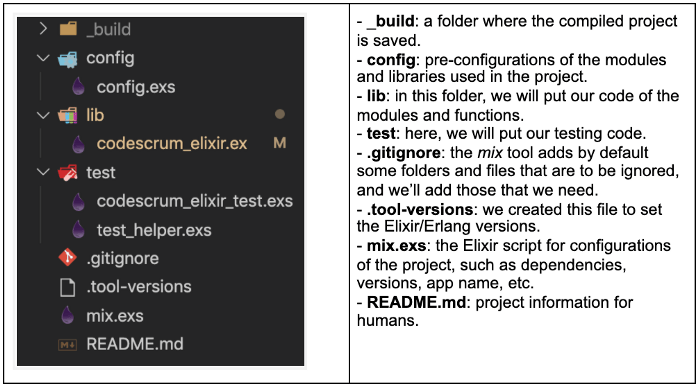
Then, let’s add some code to write a hangman game. In the lib folder, we are going to add the code to read a text plain file where we will put the words to guess:
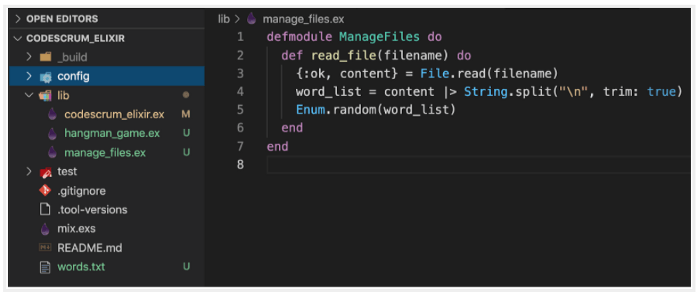
In Elixir, classes or objects concepts don’t exist; we have modules and functions to organize our application, which is all we need. So, in the code above, we have a module called ManageFiles, which contains a function called read_file with one parameter. As you can see, the syntax is very similar to Ruby one. The module starts with an uppercase letter and is usually written in CamelCase style.


As we mentioned before, Elixir uses dynamic typing, so we do not have to declare a variable type. Like Ruby’s symbols, Elixir uses atoms. These are a type of variable where the name is its own value (you can see it as :ok named in the code above). Atoms are immutables, meaning that the same helium atom is a helium atom anywhere in the universe, so the :ok atom is the same in the entire application. In the third line, we also have something called pattern matching. This is the Elixir way to retrieve some particular information from complex data types, such as lists and tuples, and the assignment expression is just the simplest form of pattern matching.


The symbol |> denotes a pipe operator, and it is similar to using pipes in Linux. So in the 4th line, the value of the content variable, goes through the split function located in the String module and splits the string, according to the given parameters and the result, which is a list (linked lists) that is saved in the word_list variable. The 5th line randomly picks out one element of the word_list and returns it (there is no explicit return in Elixir).


It looks cool, but we need to know that this piece of code is working, so we are going to prove this. Let’s execute the Elixir Interactive Shell (iex) to load the code and check what happens. First, run the iex command in your terminal, in the project folder:


This command will open the interactive shell, where you will see this prompt:

Bear in mind that the words.txt file must be in the root directory of the project to be located; otherwise, put in the relative path. The content of this file is just one word per line.


At the iex shell, you can find some help for almost all the modules and operators. For instance, if you want to know more about the pipe operator, then type:

The /2 symbol is called the function Arity, which is the number of arguments a function takes. If a function doesn’t take any argument, then its arity would be /0. Try these expressions in the Interactive shell, and see what happens:

To exit from the iex shell, type System.halt or press CTRL+G or CTRL+\ or press CTRL+C twice.

Another way to prove that our code is the correct one is by doing unit tests. So, let’s code our test. In the test folder, create a mix file (.exs) called manage_files_test.exs. The code is the following:
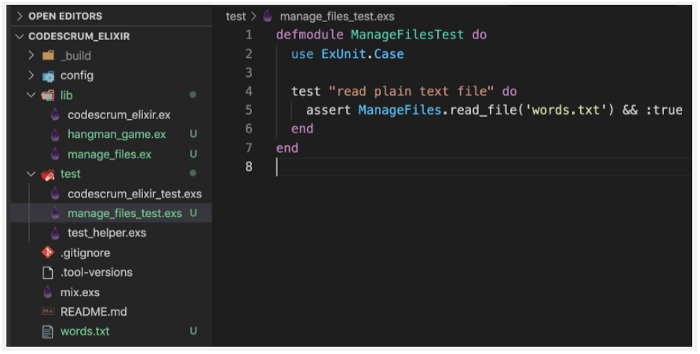

After defining the test module, we need to tell Elixir which unit test framework is going to be used. In this case, we’ll use ExUnit, which is Elixir’s official one, and shipped with Elixir, so we don’t have to install anything else.

Then, we write our test. In this case, we will use the falsy and truthy values, where the atoms nil and false are treated as falsy values, and everything else is treated as a truthy value. So, we can validate whether the read_file function returns something by using short-circuiting logical boolean operators. We could also use the boolean data type only:

Now, we can run the test:

And, if everything is OK, we have got an output like this:
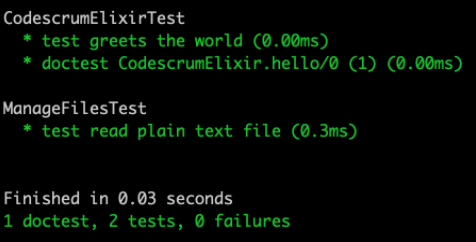
Now, in the hangman_game.ex file, we will put the logic of the game. Let’s start with this piece of code:
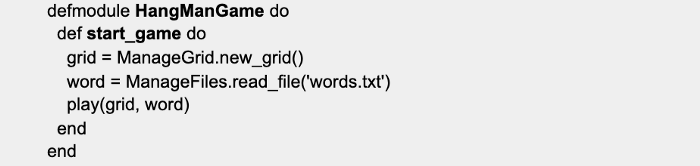
ManageGrid is a module to create, paint (print out on screen), and fill the board. You can see the complete code on the Github repository. We have seen the ManageFiles module before, and we use it to get a word to guess. Then we call the play/2 function by passing two parameters: the board and the word to guess (Arity two):

Here we have an Elixir data structure called struct. This type of structure allows us to save information during the execution of the entire application. The main difference with maps is immutability, i.e. we can predefine some fields. In our case, this structure stores the following information:

In another file, this struct is called guess.ex, which contains the module called HangMan.Guess with the fields guess_word initialized in null and attempts initialized in 6.


In the play function, we also have the while function, which is a recursive function to control the game’s flow. In Elixir, there is not the while loop that we know in Python or Ruby, as it uses recursive functions:
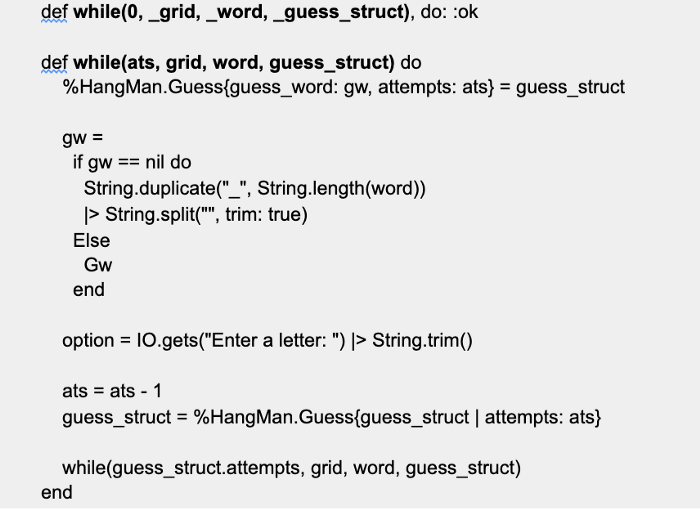

As you will notice, the name of the function can be changed for whatever you want to. We use that name just for convention. The function is called recursively until the base condition is accomplished. In this case, the base condition is when the first parameter is zero; the rest of the parameters do not matter. The base case then returns the :ok atom to indicate that everything is correct. The entire code can be found on the Github repository.

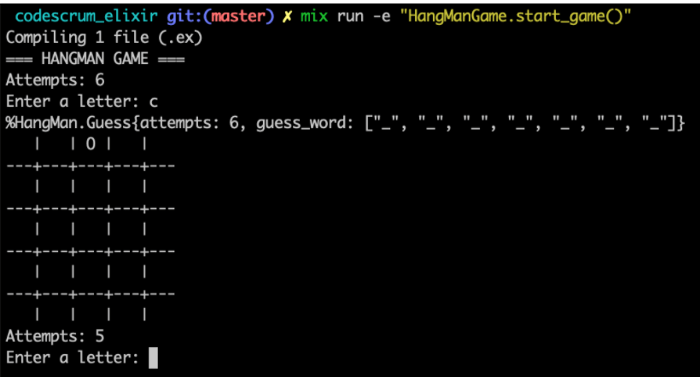
Finally, let’s run the game:

And you have got something like this:
What we use Elixir for

A Codescrum project related to Elixir was built for an asbestos removal company whose solution had three components: an API service, a frontend in ReactJS, and a mobile application. The API service was made in Elixir using the Phoenix web framework and a GraphQL implementation by using Absinthe, the GraphQL toolkit for Elixir.


Resources to learn Elixir

Here are some tutorials and courses to get you started with Elixir and its web framework Phoenix:


GitHub repository. The code of the hangman project described above has been made available in the following repository: https://github.com/edycop/elixir_hangman_game


If you have doubts about Elixir, don’t hesitate to reach out to our team! We’re always happy to hear from you, consult you, and help with any questions for Free!


Thank you for reading!
Unsloth Desktop local AI platform for developers running LLMs, RAG, fine-tuning and AI tools locally
by Gonzalo Wangüemert 15 September 2026
Explore Unsloth Desktop and how it simplifies local AI development with LLMs, RAG, fine-tuning, APIs, deep research and developer tools.
AI Loops illustration representing autonomous software development, AI coding agents and continuous
by Gonzalo Wangüemert 10 August 2026
Discover what AI loops are, how they work, and why they are transforming software development. Learn how loop engineering is shaping the future of AI-powered coding.
OpenCode AI open-source coding agent running in the terminal with AI-assisted software development w
by Gonzalo Wangüemert 2 July 2026
Discover OpenCode AI, the open-source coding agent that supports multiple AI models, advanced workflows, Agent Skills and privacy-first development.
PaperClip AI dashboard showing multi-agent company structure with CEO, researcher and engineer agent
by Gonzalo Wangüemert 1 June 2026
PaperClip AI is the open-source framework that turns AI agents into an autonomous company. Learn how to set up org charts, heartbeats, and multi-agent workflows.
Codescrum blog post thumbnail showing two AI robots and the title What Is Harness Engineering? The A
by Gonzalo Wangüemert 1 May 2026
Harness engineering is reshaping how software gets built. Here's what CTOs and founders need to know in 2026.
Google Antigravity IDE interface representing agent-first development environment for AI-assisted so
by Gonzalo Wangüemert 30 March 2026
Discover Google Antigravity IDE, a next-generation agent-first development environment designed to transform how developers build software with autonomous AI agents.
OpenClaw: The Viral AI Agent Redefining Autonomous Automation
by Gonzalo Wangüemert Villalba 20 March 2026
Artificial intelligence is undergoing a structural transformation. What began as conversational interfaces powered by large language models is rapidly evolving into autonomous systems capable of executing real world digital tasks. In this emerging landscape of AI agents, one name has attracted significant attention, OpenClaw. OpenClaw is not merely another chatbot. It represents a broader shift in how artificial intelligence systems operate, moving from reactive text generation to proactive digital execution. Its rapid rise in popularity has positioned it at the centre of discussions surrounding autonomous AI, intelligent automation and the future of digital work. This article explores what OpenClaw is, why it gained viral traction, how it works conceptually and what it signals for the next phase of AI agent development. What Is OpenClaw? OpenClaw is an AI agent designed to perform tasks in digital environments autonomously. Unlike traditional AI chat interfaces that generate responses based on prompts, OpenClaw aims to interpret objectives, plan actions and execute them across systems. At its core, OpenClaw transforms a large language model from a conversational engine into an operational agent. Rather than simply answering questions, an AI agent such as OpenClaw can interpret user goals rather than isolated prompts, break complex objectives into structured steps, interact with software interfaces and APIs, execute commands within digital environments, and adapt its actions based on contextual feedback. This distinction is fundamental. The shift from responding to acting marks a qualitative evolution in artificial intelligence. Why Did OpenClaw Go Viral? Several factors contributed to OpenClaw’s rapid visibility within the AI and developer communities. Compelling Demonstrations of Autonomous Behaviour Public demonstrations showed the agent carrying out multi-step digital tasks with minimal supervision. Observers witnessed an AI system planning, executing and iterating, not merely producing text. This display created a strong perception of progress towards genuinely autonomous AI systems. Alignment with the AI Agent Trend The rise of autonomous AI agents has been one of the most discussed developments in the post-LLM era. As businesses search for scalable automation and developers explore agent-based frameworks, OpenClaw appeared at precisely the right moment in the innovation cycle. Accessibility and Developer Interest Projects that emphasise openness, experimentation and adaptability often gain rapid traction. The idea of an AI agent that developers could explore, extend or integrate resonated strongly with the technical community. A Clear Narrative, From AI Assistant to Digital Worker OpenClaw’s positioning as an autonomous agent rather than a chatbot reframed expectations. It was presented not as a conversational novelty, but as a prototype of the future digital workforce. How Does OpenClaw Work? While implementations evolve, AI agents like OpenClaw typically rely on a layered architecture that combines reasoning, planning and execution capabilities. Large Language Model Core At the cognitive centre of the system lies a large language model. This model interprets instructions, analyses context, reasons through objectives and generates structured action plans. In this context, the language model is not the final output layer. It functions as the decision-making engine that informs action. Task Planning Mechanism A planning module translates high-level goals into manageable subtasks. If instructed to compile a report, the agent may identify required data sources, access relevant tools, extract information, structure the findings and format the output. This decomposition capability is central to autonomous behaviour. Execution Layer The execution layer enables interaction with external systems. This function may involve calling APIs, navigating software interfaces, running scripts, interacting with operating systems or managing workflows across platforms. This layer converts cognitive reasoning into operational activity. Memory and Context Management Persistent memory allows the agent to maintain coherence across extended tasks. Rather than treating each interaction in isolation, the system retains relevant context, previous steps, and intermediate outcomes. This continuity is critical for complex, multi-stage processes. OpenClaw Compared with Traditional Chatbots Traditional chatbots primarily generate textual responses based on user prompts. OpenClaw, by contrast, is designed to execute digital actions in line with user objectives. A chatbot focuses on conversational interaction. OpenClaw focuses on operational interaction with systems and tools. Traditional chat interfaces typically lack persistent, task oriented memory. OpenClaw integrates contextual memory to manage longer workflows. Chatbots do not directly manipulate external systems. OpenClaw is designed to integrate with tools, APIs and digital infrastructures. In practical terms, a chatbot communicates information. An AI agent such as OpenClaw carries out tasks. Potential Use Cases of OpenClaw The strategic relevance of OpenClaw lies in its practical applications. AI agents capable of autonomous execution could reshape multiple sectors. Enterprise Automation Businesses increasingly rely on fragmented SaaS ecosystems. An AI agent can bridge tools and automate cross-platform workflows, including reporting pipelines, CRM updates, marketing automation tasks, and structured data processing. This automated workflow reduces manual intervention and improves operational efficiency. Software Development and Testing Developers could leverage AI agents for automated code testing, environment configuration, continuous integration tasks, debugging assistance and deployment management. An AI agent that understands project context could streamline development cycles and reduce repetitive workload. Advanced Personal Productivity Beyond enterprise environments, autonomous agents may assist individuals in managing complex digital workflows, including intelligent calendar coordination, automated document handling, research aggregation and workflow orchestration across multiple tools. OpenClaw extends productivity beyond reminders and into active task completion. Strategic Implications for the Future of AI Agents OpenClaw represents more than a single project. It signals structural shifts in the development of artificial intelligence. From Conversational AI to Autonomous Systems The first generation of large language models focused primarily on dialogue. The next phase centres on execution. Competitive advantage will increasingly depend on agents that can act reliably in digital environments. Emergence of Digital Labour As AI agents become more capable, they may assume roles previously requiring human digital interaction. AI agents do not necessarily eliminate human oversight, but they do change the distribution of digital labour. Routine operational tasks could become progressively automated. Integration as Competitive Advantage Future AI value may depend less on model size alone and more on integration capacity, specifically on how effectively agents interact with real-world software ecosystems. OpenClaw reflects this integration-focused paradigm. Risks and Challenges Despite its promise, autonomous AI agents introduce substantial considerations. Granting an AI system access to digital tools requires strict governance structures. A human administrator should manage security and permissions carefully. Reliability remains critical. If an agent makes incorrect decisions during early stages of a workflow, those errors may propagate throughout the process. Governance and accountability frameworks are still developing. Questions remain regarding responsibility when autonomous systems perform unintended actions. There is also the risk of over-automation. Excessive reliance on autonomous systems could reduce human situational awareness in critical operations. Balancing autonomy with oversight will be essential for responsible adoption. Is OpenClaw the Beginning of a New AI Era? The key question is not whether OpenClaw is technically flawless today. The more important consideration is what it represents. It symbolises the evolution of artificial intelligence from passive assistant to active operator. If the conversational AI wave defined the early 2020s, the coming phase may be characterised by autonomous AI agents capable of interacting independently with digital systems. OpenClaw illustrates how large language models can transition from generating insight to delivering execution.  Whether it becomes a dominant platform or remains an early milestone, it clearly reflects a broader trajectory. Artificial intelligence is moving from conversation towards action.
The Rise of AI Agents: Anthropic’s Claude Computer Use & The Agentic Revolution
by Gonzalo Wangüemert Villalba 16 February 2026
From Chatbots to Autonomous Agents: The Next Phase of Artificial Intelligence For years, artificial intelligence has been dominated by conversational assistants capable of answering questions, generating content, and supporting knowledge work. Today, however, the industry is undergoing a far more profound transformation: the shift from chatbots to autonomous AI agents capable of acting directly within digital environments and completing tasks end-to-end. This transition, widely referred to as the Agentic Revolution , marks the emergence of a new class of systems that do not merely communicate, but observe, reason, and operate. Early projects such as Manus AI demonstrated that agents could plan, decompose complex objectives, and coordinate multi-step reasoning. Building on this foundation, Anthropic’s Claude Computer Use now represents a major leap forward: one of the first commercially available AI agents capable of using a real computer autonomously, browsing the web, interacting with graphical interfaces, and executing full workflows in the same way a human operator would. This development signals a fundamental change in how artificial intelligence interfaces with the digital world, transforming language models into fully operational digital workers. How Claude Computer Use Works: The Computer-Using Agent Model Claude Computer Use is based on the concept of a Computer-Using Agent (CUA). Rather than relying on predefined APIs or rigid automation scripts, the agent interacts directly with the operating system via the graphical user interface. The system visually perceives the screen using computer vision, recognises interface elements such as buttons, text fields, menus, and windows, and interprets them within a semantic and task-oriented context. Given a user objective, the model applies its reasoning capabilities to construct a plan by decomposing the task into a sequence of atomic actions, such as moving the cursor, clicking, typing, scrolling, and navigating between applications and web pages. Crucially, Claude does not follow a fixed script. It can adapt to unexpected interface changes, recover from errors, reassess its strategy, and continue execution dynamically. This level of flexibility distinguishes it from traditional robotic process automation and brings its behaviour much closer to that of a human digital operator. From Manus AI to Claude: The Evolution Towards Fully Operational Agents Manus AI introduced the idea of general-purpose agents capable of long-horizon reasoning, task decomposition, and tool orchestration. However, its interaction with software systems was still largely mediated through structured tools and APIs. Claude Computer Use removes this intermediary layer by allowing the agent to operate the computer directly. Any application, including legacy systems without modern integrations, becomes accessible. This shift moves autonomous agents from a conceptual framework into practical deployment, enabling real-world task execution across virtually any digital environment. Claude vs OpenAI Operator vs Google Mariner Anthropic is not alone in developing agentic systems. OpenAI and Google are pursuing similar goals, each with a distinct strategic focus. OpenAI Operator is designed for high-performance task execution across web and enterprise workflows, with deep integration into the GPT ecosystem and API-driven tooling. Its strengths lie in speed, scalability, and developer extensibility. Google Mariner focuses on autonomous web navigation and large-scale information retrieval, leveraging tight integration with Chrome, Google Search, and Google Workspace. It is particularly well-suited to research, data collection, and productivity automation within Google’s ecosystem. Claude Computer Use differentiates itself through its emphasis on general-purpose reasoning, interpretability, and safety. Anthropic has prioritised controlled autonomy, alignment, and robust governance, making Claude especially attractive for enterprise and regulated environments where reliability and risk management are critical. Business Implications: True Cognitive Task Automation Computer-using agents unlock a new level of cognitive automation that extends far beyond repetitive process scripting. In operations, they can interact with legacy systems, enter and validate data, generate reports, and coordinate internal workflows without custom integrations. In marketing and sales, they can conduct market research, perform competitive analysis, update CRMs, manage campaigns, and publish content. In finance, they can access banking portals, prepare financial statements, perform reconciliations, and support audit processes. In human resources, they can screen candidates, operate recruitment platforms, schedule interviews, and automate onboarding. These capabilities effectively create a new category of worker: the autonomous digital employee, capable of performing knowledge-intensive tasks continuously, at scale, and with near-zero marginal cost. Security and Privacy in the Age of Autonomous Agents Granting AI direct control over computers introduces unprecedented security challenges. Such agents may handle credentials, access sensitive information, and execute actions with real operational consequences. Potential risks include interface manipulation, visual prompt injection, execution errors, and insufficient auditability. In response, Anthropic has designed Claude Computer Use with layered safeguards: sandboxed environments, granular permission controls, human oversight for high-impact actions, comprehensive activity logging, and strict behavioural policies. In the agentic era, cybersecurity is no longer only about protecting data. It is about governing autonomous behaviour within complex digital infrastructures. The Shift from Chatbots to Agents The transition from chatbots to autonomous agents represents a structural change in software architecture. Chatbots respond; agents act. Chatbots operate in isolated turns; agents maintain a persistent state and long-term plans. Chatbots are reactive; agents can be proactive and goal-driven. This evolution is giving rise to the agentic economy, in which organisations orchestrate fleets of specialised agents that research, plan, execute, and coordinate with one another across digital systems. Conclusion: The Dawn of the Agentic Revolution Anthropic’s Claude Computer Use marks a decisive step in the evolution of artificial intelligence from conversational tools to operational digital entities. While Manus AI laid the conceptual groundwork for autonomous agents, Claude demonstrates their practical viability by showing that a model can control a real computer and complete complex tasks independently. The Agentic Revolution is not an incremental improvement. It is a paradigm shift: from passive tools to active digital collaborators, from assistants to operators, from software that advises to software that executes. In the coming years, competitive advantage will increasingly depend on how effectively organisations design, govern, and scale ecosystems of autonomous agents. We are witnessing the emergence of a new form of workforce: the autonomous AI workforce. And Claude Computer Use is one of the clearest early signals that this future has already begun.
World Models in Artificial Intelligence: The Next Paradigm Shift Beyond Large Language Models
by Gonzalo Wangüemert Villalba 21 January 2026
Artificial Intelligence has made extraordinary progress over the last decade, largely driven by the rise of large language models (LLMs). Systems such as GPT-style models have demonstrated remarkable capabilities in natural language understanding and generation. However, leading AI researchers increasingly argue that we are approaching diminishing returns with purely text-based, token-prediction architectures. One of the most influential voices in this debate is Yann LeCun, Chief AI Scientist at Meta, who has consistently advocated for a new direction in AI research: World Models. These systems aim to move beyond pattern recognition toward a deeper, more grounded understanding of how the world works. In this article, we explore what world models are, how they differ from large language models, why they matter, and which open-source world model projects are currently shaping the field. What Are World Models? At their core, world models are AI systems that learn internal representations of the environment, allowing them to simulate, predict, and reason about future states of the world. Rather than mapping inputs directly to outputs, a world model builds a latent model of reality—a kind of internal mental simulation. This enables the system to answer questions such as: What is likely to happen next? What would happen if I take this action? Which outcomes are plausible or impossible? This approach mirrors how humans and animals learn. We do not simply react to stimuli; we form internal models that let us anticipate consequences, plan actions, and avoid costly mistakes. Yann LeCun views world models as a foundational component of human-level artificial intelligence, particularly for systems that must interact with the physical world. Why Large Language Models Are Not Enough Large language models are fundamentally statistical sequence predictors. They excel at identifying patterns in massive text corpora and predicting the next token given context. While this produces fluent and often impressive outputs, it comes with inherent limitations. Key Limitations of LLMs Lack of grounded understanding: LLMs are trained primarily on text rather than on physical experience. Weak causal reasoning : They capture correlations rather than true cause-and-effect relationships. No internal physics or common sense model: They cannot reliably reason about space, time, or physical constraints. Reactive rather than proactive: They respond to prompts but do not plan or act autonomously. As LeCun has repeatedly stated, predicting words is not the same as understanding the world . How World Models Differ from Traditional Machine Learning World models represent a significant departure from both classical supervised learning and modern deep learning pipelines. Self-Supervised Learning at Scale World models typically learn in a self-supervised or unsupervised manner. Instead of relying on labelled datasets, they learn by: Predicting future states from past observations Filling in missing sensory information Learning latent representations from raw data such as video, images, or sensor streams This mirrors biological learning: humans and animals acquire vast amounts of knowledge simply by observing the world, not by receiving explicit labels. Core Components of a World Model A practical world model architecture usually consists of three key elements: 1. Perception Module Encodes raw sensory inputs (e.g. images, video, proprioception) into a compact latent representation. 2. Dynamics Model Learns how the latent state evolves over time, capturing causality and temporal structure. 3. Planning or Control Module Uses the learned model to simulate future trajectories and select actions that optimise a goal. This separation allows the system to think before it acts, dramatically improving efficiency and safety. Practical Applications of World Models World models are particularly valuable in domains where real-world experimentation is expensive, slow, or dangerous. Robotics  Robots equipped with world models can predict the physical consequences of their actions, for example, whether grasping one object will destabilise others nearby. Autonomous Vehicles By simulating multiple future driving scenarios internally, world models enable safer planning under uncertainty. Game Playing and Simulated Environments World models allow agents to learn strategies without exhaustive trial-and-error in the real environment. Industrial Automation Factories and warehouses benefit from AI systems that can anticipate failures, optimise workflows, and adapt to changing conditions. In all these cases, the ability to simulate outcomes before acting is a decisive advantage. Open-Source World Model Projects You Should Know The field of world models is still emerging, but several open-source initiatives are already making a significant impact. 1. World Models (Ha & Schmidhuber) One of the earliest and most influential projects, introducing the idea of learning a compressed latent world model using VAEs and RNNs. This work demonstrated that agents could learn effective policies almost entirely inside their own simulated worlds. 2. Dreamer / DreamerV2 / DreamerV3 (DeepMind, open research releases) Dreamer agents learn a latent dynamics model and use it to plan actions in imagination rather than the real environment, achieving strong performance in continuous control tasks. 3. PlaNet A model-based reinforcement learning system that plans directly in latent space, reducing sample complexity. 4. MuZero (Partially Open) While not fully open source, MuZero introduced a powerful concept: learning a dynamics model without explicitly modelling environment rules, combining planning with representation learning. 5. Meta’s JEPA (Joint Embedding Predictive Architectures) Yann LeCun’s preferred paradigm, JEPA focuses on predicting abstract representations rather than raw pixels, forming a key building block for future world models. These projects collectively signal a shift away from brute-force scaling toward structured, model-based intelligence. Are We Seeing Diminishing Returns from LLMs? While LLMs continue to improve, their progress increasingly depends on: More data Larger models Greater computational cost World models offer an alternative path: learning more efficiently by understanding structure rather than memorising patterns. Many researchers believe the future of AI lies in hybrid systems that combine language models with world models that provide grounding, memory, and planning. Why World Models May Be the Next Breakthrough World models address some of the most fundamental weaknesses of current AI systems: They enable common-sense reasoning They support long-term planning They allow safe exploration They reduce dependence on labelled data They bring AI closer to real-world interaction For applications such as robotics, autonomous systems, and embodied AI, world models are not optional; they are essential. Conclusion World models represent a critical evolution in artificial intelligence, moving beyond language-centric systems toward agents that can truly understand, predict, and interact with the world. As Yann LeCun argues, intelligence is not about generating text, but about building internal models of reality. With increasing open-source momentum and growing industry interest, world models are likely to play a central role in the next generation of AI systems. Rather than replacing large language models, they may finally give them what they lack most: a grounded understanding of the world they describe.
The AI Revolution: 25 Essential Tools for Professional Excellence in 2026
by Gonzalo Wangüemert Villalba 20 December 2025
The Artificial Intelligence (AI) landscape at the close of 2025 is defined by unprecedented velocity. We are at the threshold of 2026, a year widely expected to be when many experimental AI features become mandatory professional standards. Even seasoned experts struggle to keep pace with the sheer volume of new models and updates being launched monthly. This accelerated innovation, however, presents monumental opportunities for professionals and businesses to optimise operations, achieve significant efficiency gains, and ultimately boost revenue. This in-depth article, curated in late 2025, highlights 25 pivotal AI tools that are either already dominant or projected to become indispensable for professional excellence in 2026. We’ve focused on foundational models designed for massive scale, alongside powerful wrappers and specialised tools that deliver genuinely transformative value today and will define the next year. Foundational Models and the Rise of Autonomous Agents The focus is rapidly shifting from the Large Language Model (LLM) as a simple responder to the LLM as an Autonomous Agent, a coordinator of complex actions and workflows. 1. ChatGPT (OpenAI) : The most well-known tool, whose key evolution is the consolidation of Autonomous Agents. By 2026, these agents are expected to transition from testing to real-world management of complex tasks (market research, budget tracking, workflow coordination) through advanced Connectors. 2. Alternative LLM Platforms ( Claude , Gemini , Grok ): These competitors are rapidly redefining the standard of precision and utility. Claude excels with complex legal/academic documents, Gemini leads in multimodal understanding, and Grok is preferred for speed and real-time social context. Professionals must benchmark these models for specialised tasks. 3. Domain-Specific Language Models (DSLM): A strong prediction for 2026: the mass adoption of models trained exclusively on narrow domains (e.g., legal, medical, financial data). They offer the precision and reliability essential for highly regulated sectors, surpassing general LLMs. Visual, Video, and Media Production Tools The era of low-quality synthetic content is ending. The market now demands cinematic quality, fidelity, and consistency for marketing and creation. 4. Midjourney : The industry standard for artistic and high-fidelity image generation. Its unparalleled value lies in its aesthetic quality and a highly engaged community that openly shares complex prompts, driving rapid artistic innovation. 5. Nano Banana Pro (Gemini AI): Google’s cutting-edge image generation and editing suite (powered by Gemini 3 Pro). Its anticipated late 2025/early 2026 release is set to disrupt the market by offering 4K output, superior text rendering, and robust character consistency, crucial for professional branding. 6. Veo (Google Video Generation): The imminent successor to previous Google video models. The key expectation for 2026 is that this tool will eliminate time and quality constraints, pushing long-form video generation into the mass-adoption phase for marketing and content houses. 7. Synthesised Avatars (e.g., Aven): Already used for corporate training and e-learning. Its adoption is poised to grow exponentially in 2026, making it the fastest method for generating compliant, multilingual training videos from text scripts alone. Audio, Voice, and Music Workflow AI-generated audio has reached professional-quality standards, improving post-production efficiency and accelerating music creation. 8. Eleven Labs : The undisputed leader in AI voice generation (TTS). Its synthetic voice output is now virtually indistinguishable from human narration, making it the standard for audiobooks and corporate messaging. 9. Submagic : A critical wrapper for content creators. Its Long-Form Clipper feature is revolutionary, automatically analysing a long video and extracting the most engaging moments to create dozens of pre-subtitled, short-form clips (Shorts, Reels). 10. Suno : The tool that creates complete songs (lyrics, melody, instrumentation, and vocals) from a simple text prompt. Its rapid adoption by content creators and indie game developers is starting to reshape the music licensing landscape. 11. Adobe Speech Enhancer : An essential post-production tool. It uses AI to drastically clean and improve poor-quality audio (removing echo and noise) to achieve near-studio quality, a must-have for remote production teams. Development, Automation, and Business Infrastructure AI is now the fundamental infrastructure that enables end-to-end operational automation and accelerated product development. 12. Nvidio : A sophisticated wrapper that automates the full video creation cycle (scripting, voiceover, and visual assembly) based on a simple topic prompt, drastically reducing production time and cost. 13. Horizons (Hostinger) : A no-code/low-code platform that allows users to create functional WebApps and MVPs through conversation with the AI, making rapid prototyping and business idea validation accessible to everyone. 14. Lovable : A more technical, low-code alternative to Horizons, offering greater control for users who need to refine and heavily customise the AI-generated code for specific web application requirements. 15. Cursor : The AI-powered code editor is rapidly becoming the developer standard. It acts as an advanced co-pilot, not only suggesting code but also debugging, explaining, and generating complex frameworks, defining the modern coding workflow. 16. BuildYourStore : A highly specialised tool that automates the creation of an entire e-commerce business. It designs the Shopify store, generates product content, and automatically connects it to a supplier for a ready-to-launch dropshipping model. 17. N8N : A crucial Integration Platform as a Service (IPaaS). This tool is critical to 2026, as it integrates and orchestrates multiple AI models to build robust multi-agent systems for complex automation (e.g., customer service, scheduling, and content publishing). Efficiency, Professional Development, and Data Management Daily productivity is being redefined by AI tools that integrate seamlessly and intuitively into the existing professional workflow. 18. Canva Magic Studio: The AI suite integrated into Canva. Tools like smart presentation creation, background removal, and text-to-image generation are now commonplace, democratising high-quality design across all sectors. 19. Slides AI : An essential productivity tool that instantly transforms any lengthy document, notes, or script into a professionally structured presentation, saving crucial hours in slide creation. 20. Merlin : A simple yet powerful utility that brings LLM functionality to any web tab or YouTube video. It provides instant contextual summaries and Q&A, allowing users to analyse information without disrupting their browsing flow. 21. Hitem 3D : The "ChatGPT for 3D." It generates complete, textured 3D models from text or 2D images. This capability is rapidly accelerating prototyping, game development, and the creation of digital assets. 22. Google Earth Studio : Utilises AI-constructed 3D models of the world to create cinematic videos and timelapses. Essential for professionals who need high-quality aerial footage without the cost and logistics of using a physical drone. 23. Fireflies : A vital tool for enterprise efficiency. It automatically records, transcribes, and generates summaries of all calls and meetings, ensuring accountability, compliance, and easily searchable knowledge transfer within teams. 24. Google AI Studio (Stream Functionality): A cutting-edge feature where the AI observes the user's screen in real-time to offer procedural guidance. It serves as an intelligent assistant, guiding users through complex software tasks and reducing the need for traditional training. 25. The Next-Gen Personalised Learning AI (Concept): The most critical tool for future-proofing. This agent monitors a professional's performance, identifies knowledge gaps, and autonomously generates custom learning modules and projects for continuous, accelerated reskilling in an ever-changing market. Staying disconnected from this progress, even for six months, can create a significant professional lag. AI is not a trend to be resisted; it is the present and the future, and mastering these tools is fast becoming a requirement for professional excellence.